

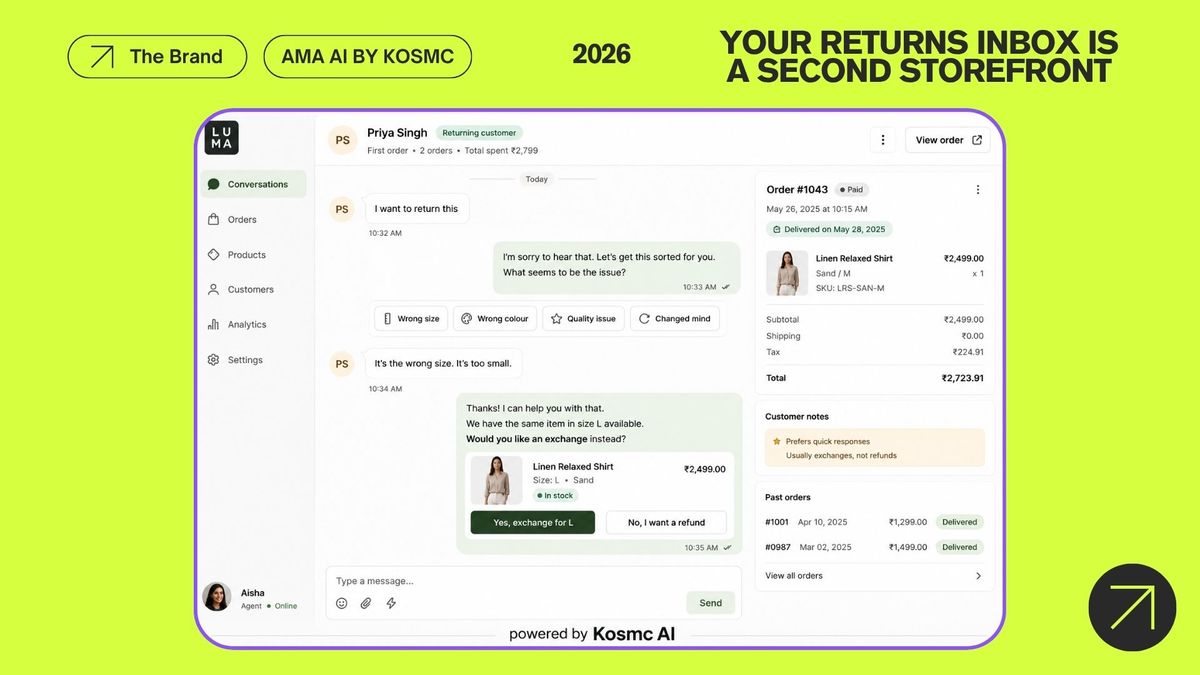
Your Returns Inbox Is a Second Storefront
Every refund request is a purchase decision still in progress. Most brands answer it with a shipping label.
A customer who asks for a refund has not left. They bought from you, they waited for the parcel, they opened it, and now they are telling you - unprompted, in their own words, for free, exactly what was wrong with the product.
That is better information than anything your product page collected. And the standard response to it is a link to a policy PDF.
Why does a refund request carry more intent than a product page view?
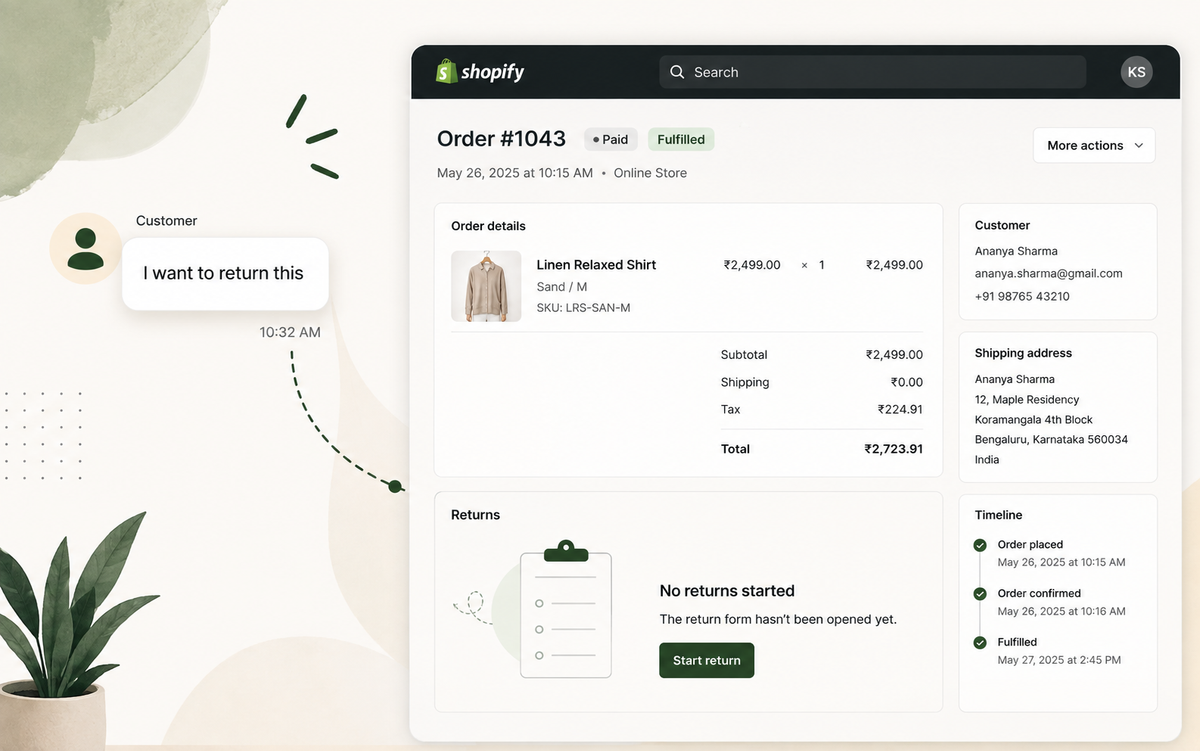
A product page view tells you someone looked. A return request tells you someone bought, formed an opinion, and is willing to spend effort communicating it.
A return request is a purchase decision in progress: the customer is still in-market, still holding a payment method they already trusted you with, and still describing a specific unmet need. The window between "I want to return this" and "label sent" is the highest-intent, worst-instrumented surface a D2C brand owns.
Think about what a brand actually knows in that moment:
- The exact SKU, size, and variant the customer chose
- What they expected it to be
- What it turned out to be instead
- That they were willing to pay full price for the category, today
- That they are, right now, actively engaged with your brand
Marketing teams spend most of their budget trying to buy a colder version of that. Support teams get it handed to them and close the ticket.
What actually decides whether a return becomes a refund or an exchange?
Not the policy. Not the discount. The next question.
If the next thing the customer sees is a returns form, the outcome is a refund. If the next thing they see is a question, the outcome is open.
Here is the sequence that decides it. Call it the Four Questions Before the Label:
- Which order, and which item? Not "please share your order ID." The system should already know, because it can look. Making a customer dig through their email to prove they bought from you is the first thing that turns a fixable problem into a refund.
- What actually went wrong? Fit, colour, quality, timing, or changed mind. These are five completely different problems and only two of them are unrecoverable. A brand that logs "return: apparel" instead of "return: sleeve length on the 38, customer wanted the 40" has thrown away the only useful part of the interaction.
- Is there a version of this that fixes it? The larger size. The same cut in a different fabric. The adjacent SKU that solves the actual complaint. This question requires knowing the catalogue and the customer at the same time.
- Do you want that instead, right now? Not "you can browse exchanges here." The offer, made in the same conversation, executable in the same conversation.
Most brands ask question two, sometimes, several hours late, by email. Questions one, three and four are the ones that move money, and almost nobody asks them.
Why doesn't your current support tool ask them?
Because it was built to close tickets, and closing tickets is not the same job as keeping customers.
Support tooling has been optimised for the wrong number for a decade. The dashboards report deflection: how many conversations were resolved without a human touching them. Deflection is a cost metric wearing a growth metric's clothes. A customer who gave up and requested a refund through the self-service portal counts as a win on that dashboard.
There is also a structural reason. Most brands run discovery and support as two separate systems, because they are two separate line items on an org chart. The customer does not experience it that way. "Will this fit me?" is a support question before purchase and a returns question after it, and it is the same question both times.
The split is an internal artefact. The customer is having one continuous conversation with your brand, and you have deliberately cut it in half.
What changes when the agent can execute the return itself?
This is the line that separates a support bot from a support agent, and it is testable in about ten seconds on any tool you are currently paying for.
Ask it: "I want to return this."
A bot replies with the returns policy. An agent asks which order, what went wrong, and whether a different size would fix it.
AMA AI, Kosmc's Shopify-connected concierge, does the second thing. It understands the intent behind the message rather than matching keywords, asks counter-questions until it has enough to actually resolve the problem, checks the order and inventory data itself, and then executes the return or exchange inside Shopify. Not a form. Not a ticket routed to a human queue at 9am tomorrow. The resolution happens inside the conversation, at whatever hour the customer decided to open the parcel.
Execution is the whole difference. An agent that can only recommend an exchange has added a step. An agent that can complete one has replaced the refund.
Kosmc is an Official Shopify Business Partner, which is what makes the order lookup, inventory check, and exchange creation happen natively against the store rather than through a scraped or synced copy of it that goes stale.
Isn't this just talking customers out of refunds?
No, and getting this wrong is how brands destroy trust at exactly the moment it is most fragile.
There is a real version of this that is manipulative: a bot that buries the refund option, adds friction, and wears the customer down. It works for one quarter and shows up as a review problem for the next four.
The honest version is different. Someone who received the wrong size did not want their money back. They wanted the right size. The refund is what they settle for when nobody offers the alternative fast enough. Offering the exchange first, clearly, with the refund still one message away, is a better experience than a shipping label and if the customer says no, the agent should process the refund immediately without a second attempt.
The test is simple: does the customer get to a refund faster than they would have on the portal if that is what they still want? If yes, you are helping. If no, you are churning them politely.
What does a brand actually gain here beyond the recovered sale?
Three things, and the third is the one that compounds.
Margin, immediately. Every repetitive question your team answers by hand costs salary and returns nothing. Where is my order. Does this run small. Can I exchange for a large. Do you ship here. That work is answered daily, forever, and none of it accumulates into anything. Automating it is not a headcount story; it is a story about your best people spending their hours on the conversations that actually need a human.
Availability at the hour it matters. Parcels get opened at night and on Sundays. A return question that waits eighteen hours for a reply has already become a refund in the customer's head. Resolution has a half-life.
Post-purchase intent data. This is the part almost nobody instruments. Every structured return conversation produces a clean record of what the customer expected versus what they received. Enough of those and you are not looking at a support log, you are looking at a product brief: which SKU runs small, which product photography is overpromising, which size curve is wrong for your actual customer. That signal exists in every brand's inbox today, sitting in unstructured email threads, unread.
The agent that handles the conversation is also the thing that captures it in a shape you can query later.
Where this fits in the agentic commerce story
Most of the agentic commerce conversation right now stops at checkout. Agent finds the product, agent answers the questions, agent closes the sale, everyone claps.
Then the parcel arrives in the wrong size and a human with a spreadsheet takes over.
Half the loop got automated, and it was not the expensive half. Discovery is the fun problem. Post-purchase is where the margin actually leaks: in returns, in refunds that should have been exchanges, in support hours spent on questions the system already had the answer to, and in a decade of intent data nobody stored in a usable form.
Agentic commerce that ends at checkout is a demo. Agentic commerce that survives the parcel arriving is a business.
What to do about it this week
You do not need to buy anything to start on this.
- Pull your last fifty return requests and tag them by actual reason: fit, colour, quality, timing, changed mind. If your current system cannot produce that breakdown, you have found the first problem.
- Count how many of them a same-size-up exchange would have solved.
- Check the median time between a customer's first return message and your first reply. Then check how many of those messages arrived outside working hours.
- Look at what your support tool does when someone types "I want to return this." If it replies with a policy instead of a question, you know where you stand.
The brands that win the next few years will not be the ones with the best returns policy. They will be the ones who treated the returns conversation as a sales conversation, because that is what the customer was having the entire time.
Your product page gets one shot at the sale. Your returns inbox gets a second one, with better information and a warmer customer. Most brands are answering it with a PDF.
https://kosmc.ai
Questions, answered.

Ankur Gupta is an entrepreneur and Founder & CEO of Kosmc AI. Passionate about the future of commerce, he is building products that help brands and creators turn attention into measurable revenue. He writes about AI, the creator economy, social commerce, and the technological shifts shaping the next decade of consumer behavior.